A bottle of kombucha costs between Rs 150 and Rs 350 in India, which is roughly what two full meals of dal-chawal cost. The label asks you to spend it on a promise: that the living culture inside will balance your gut. And the question almost nobody asks before paying is the one that matters most. What is actually alive in that bottle, and what has any of it ever been shown to do?
Walk past the glowing Instagram ads and the taproom taps, and you find a drink whose microbial contents shift from batch to batch, whose strains have no record of clinical benefit in humans, and whose label quietly sidesteps the subject of sugar. That is not to say kombucha is bad for you. It is to say the word “probiotic” is doing a lot of work on that bottle, and the evidence behind it is thin.
What kombucha actually is
Strip away the branding and kombucha is exactly what it has been for centuries: sweet tea fermented with a living culture. Brew black or green tea, dissolve sugar in it, add a SCOBY, the rubbery disc of bacteria and yeast that home brewers call the mother, and let it sit for a week or two. Yeasts convert part of the sugar into alcohol and carbon dioxide, which gives the drink its fizz. Bacteria then turn much of that alcohol into acetic and other organic acids, which give kombucha its sharp, sour bite. The drink is believed to have originated in what is now the Manchuria region of Northeast China, and it has been brewed in kitchens around the world for generations (Villarreal-Soto, Journal of Food Science, 2018).
What ends up in your glass is a blend of organic acids, tea polyphenols, some B vitamins, whatever sugar fermentation did not consume, a small amount of alcohol, typically 0.5% to 3% ABV and still rising in the bottle, and live microorganisms. That last point deserves a straight line: in a controlled study, alcohol biomarkers were detectable in urine in 83% of participants after drinking ordinary kombucha (Li, Journal of Analytical Toxicology, 2022), so it is not a zero-alcohol drink. Worth knowing if you avoid alcohol for religious reasons, are pregnant, or are subject to alcohol testing. That list sounds wholesome. The problem begins the moment you ask who those microorganisms are, and what any of them has been shown to do in a human gut.
Where the evidence is real
What is actually in the bottle is now well characterised, and it is not a probiotic cast. A culture-independent study of multiple kombucha samples found acetic acid bacteria dominant, with Gluconacetobacter present in most samples and lactobacilli in some, alongside a dominant yeast, Zygosaccharomyces (Marsh, Food Microbiology, 2014). These are the workhorses of fermentation. They are excellent at making acid and cellulose. None of them is a strain with a demonstrated benefit in the human intestine.
The batch problem is real, and it is fundamental. The same study found the microbial mix shifted between samples (Marsh, Food Microbiology, 2014). A living fermentation is inherently variable, the temperature of your kitchen, the tea you used, the age of the culture and how long it sat all influence the outcome, so your Tuesday bottle can carry a very different community from your Thursday bottle off the same shelf. A clinical probiotic tells you the strain by name and the dose by number. Kombucha cannot.
The word “probiotic” has a strict definition, and it is worth defending. In 2014, the International Scientific Association for Probiotics and Prebiotics set down what a product must be to earn the name: a defined strain, alive in sufficient numbers at the point of use, and demonstrated to provide a benefit in controlled human studies (Hill, Nature Reviews Gastroenterology & Hepatology, 2014). That definition exists precisely so that a term with real health weight cannot be claimed by any drink with a few bacteria floating in it. It is also the standard most commercial probiotic products fail to meet, which we dig into in our guide to why most probiotics don’t work.
What kombucha has actually been shown to do is modest. A 2000 review of the literature could point only to a handful of studies, mostly in-vitro tests of antimicrobial activity and animal work, and the human evidence has stayed thin since; the claimed health effects have always run far ahead of it (Greenwalt, Journal of Food Protection, 2000). The same review flagged a small number of reported adverse cases in the literature, several linked to improperly prepared brews. That is a fairness caveat, not a scare story: for most healthy adults, commercial, properly made kombucha is generally safe to drink. It is not for everyone, and we get to that below.
The digestion question is genuinely mixed, and honesty matters here. The older claim that the stomach kills every kombucha microbe was too absolute. A 2025 study using simulated digestion found viable microbes, around a hundred thousand per millilitre, surviving simulated stomach and intestinal conditions, with antioxidant and antimicrobial activity persisting after digestion (Ghion, Foods, 2025). But surviving digestion is not the same as delivering a benefit. The strains still have no demonstrated effect in humans, and the study itself notes that kombucha falls short of the criteria required for probiotic classification.
Who should skip it. Most published adverse reports are linked to contaminated or improperly prepared home brews, but they are a real caution for specific groups. Case reports include a serious metabolic complication after heavy kombucha consumption in a person living with HIV (SungHee Kole, Journal of Intensive Care Medicine, 2009), and a case of liver toxicity associated with regular kombucha intake (Gedela, South Dakota Medicine, 2016). If you are immunocompromised, pregnant, or have liver disease, skip kombucha, and avoid home brews of unknown provenance regardless. For everyone else, occasional commercial kombucha is a beverage, not a risk.
Where the popular claims fail
“Kombucha is a probiotic.” It contains live microbes, and that is where the comparison ends. It has no defined strains, no stable counts and no demonstrated benefit in humans, all three of which the probiotic definition demands (Hill, Nature Reviews Gastroenterology & Hepatology, 2014). Calling it a probiotic is like calling any sparkling water with bubbles “champagne.”
“Kombucha heals your gut and detoxifies your liver.” There is no human evidence for these claims. The scientific literature on kombucha’s health effects is mostly in-vitro and animal work, and the claims outstrip what those studies can support (Greenwalt, Journal of Food Protection, 2000). If a drink really healed gut disease, it would be a drug, not a beverage.
“The SCOBY is a super-culture your gut needs.” The SCOBY’s dominant organism is a species of Gluconacetobacter, superb at its actual job: producing the cellulose that makes the rubbery disc and gives kombucha its mouthfeel (Marsh, Food Microbiology, 2014). Nobody has shown that bacterial cellulose or its producers do anything useful in your intestine. The magic is manufacturing, not medicine.
“Kombucha is basically sugar-free.” Fermentation consumes some of the sugar, not all of it. A typical commercial bottle carries roughly 7 to 20 g of leftover sugar per 330 ml, and brands that add fruit juice or sweetener after fermentation land at the top of that range, so check the panel. It is a “health drink” whose sweet taste often comes from exactly what you are trying to avoid.
Common signs your kombucha habit is not a probiotic fix
- The label names no strains and gives no live count. A genuine probiotic tells you who is in there and how many. Kombucha labels usually avoid both.
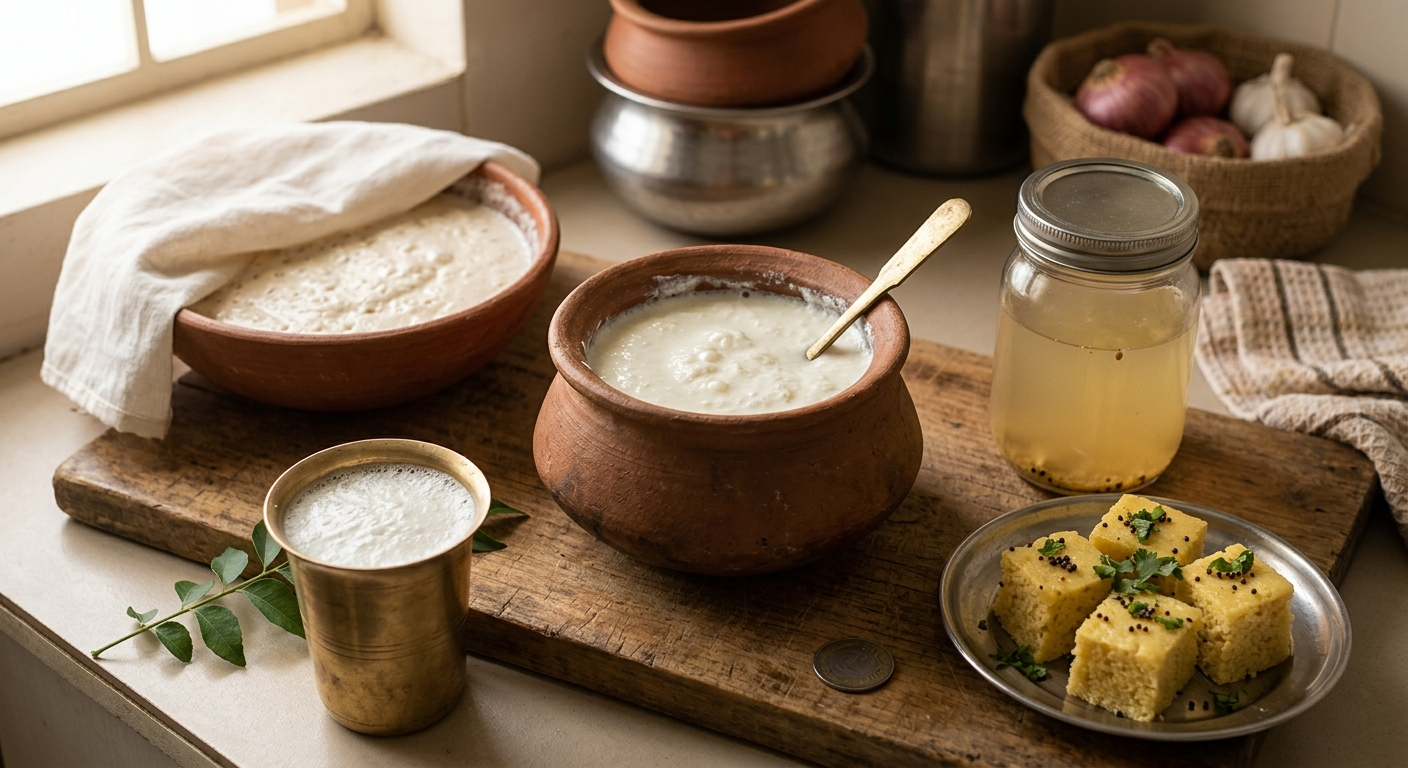
- It is your only fermented food. If the bottle is standing in for dahi, chaas, idli and kanji, you are paying a premium for less variety than the kitchen already provides.
- You expect a specific symptom to change. Drinking kombucha to fix bloating or “balance” your gut is betting on an outcome the evidence does not support.
- It is pasteurised or filtered but still called probiotic. Heat and filtration can reduce or kill live cultures; a bottle that cannot deliver live microbes is a soft drink with a story.
- You are spending more on it than on vegetables and dahi. The real gut levers cost a fraction of the bottle.
The Indian angle: dahi does the job for Rs 15
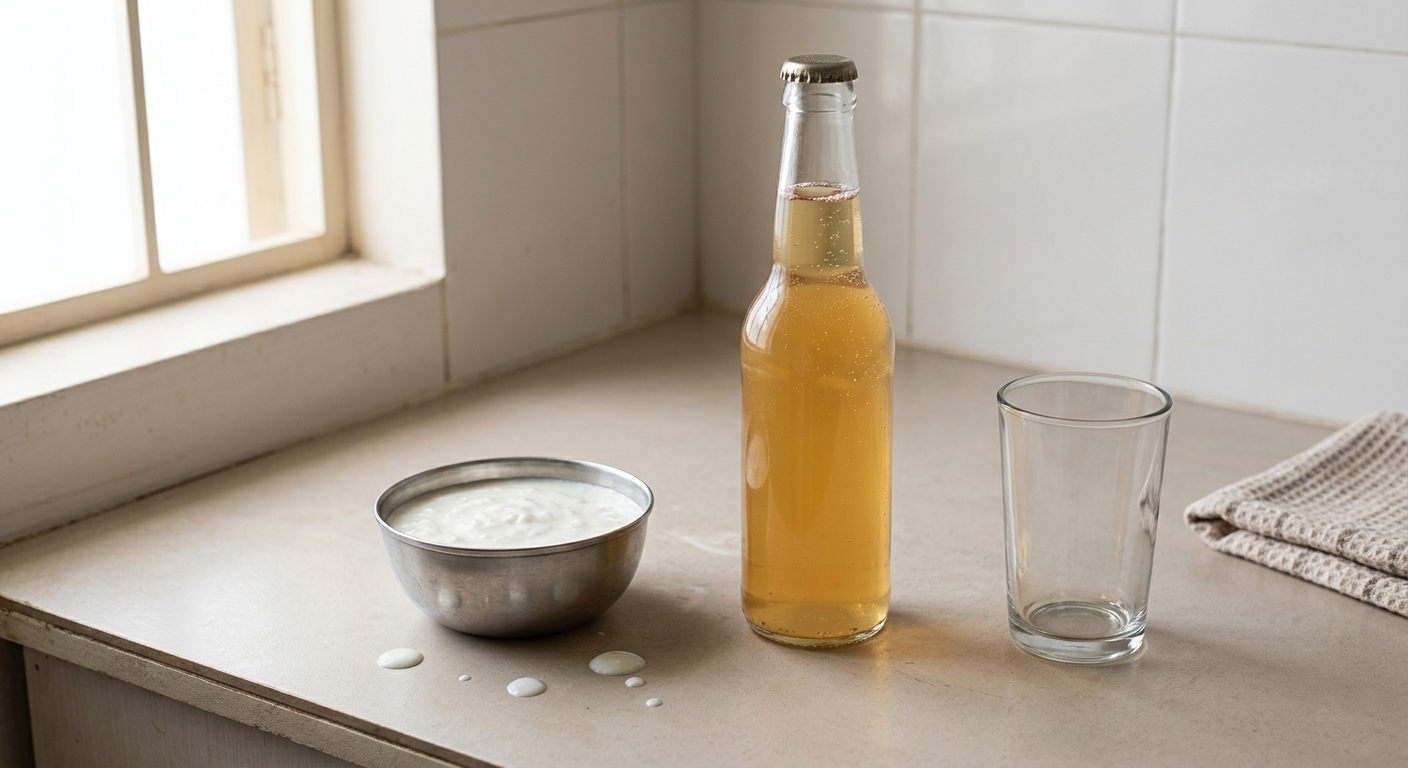
Price per microbe, the comparison is not close. A kombucha bottle at Rs 150 to Rs 350 delivers an unpredictable mix of organisms with no record of human gut benefit. A bowl of homemade dahi, made from roughly Rs 15 to Rs 20 of milk, delivers live lactic acid bacteria in quantities measured in billions of live cells per serving. Be honest about the comparison, though: home-set dahi is also a spontaneous ferment with a variable culture, made by back-slopping from the previous batch, so it is not a probiotic either by the strict ISAPP definition. What it has over kombucha is price, a food matrix your gut already knows, and a far longer safety record, not strain-level evidence. For a closer look at the science of dahi, kanji and the other ferments on the Indian plate, see our guide to Indian fermented foods.
There is a deeper point hiding here. Research on fermented foods around the world notes that while Western markets rely on defined starter cultures and standardised products, the fermented foods of Asia have long been spontaneous, varied and tied to the home kitchen (Tamang, Comprehensive Reviews in Food Science and Food Safety, 2020). India is a superpower of exactly this kind of ferment: idli and dosa batter, kanji, dhokla, curd rice, chaas, the fermented repertoire of every region. These deliver live cultures in a food matrix your body understands, at prices that do not sting, without a trendy label. The microbes your family has eaten for generations cost less than a bus ticket, and the diet that carries them is covered in our guide to the Indian diet and the microbiome.
The opportunity cost is the sharpest way to see it. That Rs 250 spent on kombucha is Rs 250 not spent on seasonal vegetables, dal or the starter for a week of dahi, the very things the microbes you already have are waiting for.
How the options compare
| What it is | What it does | Evidence | Cost | Bottom line |
|---|---|---|---|---|
| Commercial kombucha | Fermented tea with variable live microbes | No defined strains; no human gut benefit shown | Rs 150–350 per 330 ml | Pleasant drink, unproven probiotic |
| A named-strain probiotic | Delivers one defined organism at a stated dose | Well-documented for specific strains and uses | Rs 300–1,500 a month | Valid when it matches the condition |
| Dahi and traditional Indian ferments | Live cultures in a food your gut knows | Undefined mixed cultures, like kombucha; strong safety record and good nutrient matrix, but not a probiotic by the ISAPP definition either | Rs 15–20 per serving | The best value live-culture food |
What actually helps
- Eat fermented foods as food, not as medicine. Dahi, chaas, idli, dosa, kanji and dhokla deliver live cultures in a matrix your gut already understands, at prices that make kombucha look like a luxury.
- Feed the microbes you already have. The organisms your gut rewards you for feeding want fibre, dal, vegetables and whole grains, not sugar. This is where the durable changes come from.
- If you enjoy kombucha, drink it for taste. Treat it like a premium cold drink: a reasonable beverage, not a treatment. An occasional bottle does no harm for most healthy adults; skip it if you are immunocompromised, pregnant, or have liver disease.
- Check the label if you are paying for live cultures. Look for named strains, no pasteurisation mark, and the sugar content. If none of that is stated, you are paying for a story.
- Do not replace medical care or a prescribed probiotic with a beverage. If a doctor recommended a specific probiotic strain for a specific problem, a bottle of kombucha is not a substitute for it.
BioMeBar: from guessing to knowing
Most of the kombucha debate is people guessing about microbes they cannot see. BioMeBar reads what is actually in your gut, which microbes are present and how your community compares with reference populations, then matches foods, fermented foods and any targeted supplement to what is genuinely there. That turns a trend-driven decision, whether to spend Rs 250 on a mystery culture, into one based on your own data. To be clear about the limits: sequencing describes what is present; whether test-guided food and strain selection improves outcomes has not been demonstrated in randomised trials, and it does not replace medical care.
Does kombucha survive stomach acid?
Partially. Older claims that the stomach kills every kombucha microbe were overstated; a 2025 simulated-digestion study found viable microbes surviving simulated stomach and intestinal conditions (Ghion, Foods, 2025). But surviving is not the same as helping: the strains still have no demonstrated effect in humans, and the surviving counts are far below what a purpose-built probiotic delivers.
Is kombucha healthier than a cold drink?
In most ways, yes. It has tea polyphenols, organic acids and generally less sugar than a soft drink. But that makes it a reasonable beverage, not a gut treatment. If you like the taste, drink it for that.
Is kombucha better than dahi for my gut?
Not as a probiotic, and not on price. Dahi is a fraction of the price and delivers billions of live organisms in a food your gut knows. But be honest: home-set dahi is also a spontaneous, variable ferment, so it is not a probiotic by the strict definition either. What it has over kombucha is price, a longer food-safety record, and a better nutrient matrix.
Should I stop drinking kombucha?
Only if it is replacing better food choices or costing you more than it is worth. For most healthy adults, there is nothing harmful about an occasional bottle of properly made kombucha. That does not apply to everyone: if you are immunocompromised, pregnant, or have liver disease, skip it, and avoid home brews of unknown provenance. The point is to stop treating it as medicine.
References
- Hill C, Guarner F, Reid G, et al. Expert consensus document: the International Scientific Association for Probiotics and Prebiotics consensus statement on the scope and appropriate use of the term probiotic. Nature Reviews Gastroenterology & Hepatology, 2014.
- Marsh AJ, O’Sullivan O, Hill C, Ross RP, Cotter PD. Sequence-based analysis of the bacterial and fungal compositions of multiple kombucha (tea fungus) samples. Food Microbiology, 2014.
- Villarreal-Soto SA, Beaufort S, Bouajila J, Souchard JP, Taillandier P. Understanding kombucha tea fermentation: a review. Journal of Food Science, 2018.
- Greenwalt CJ, Steinkraus KH, Ledford RA. Kombucha, the fermented tea: microbiology, composition, and claimed health effects. Journal of Food Protection, 2000.
- Tamang JP, Cotter PD, Endo A, et al. Fermented foods in a global age: East meets West. Comprehensive Reviews in Food Science and Food Safety, 2020.
- Ghion G, Sica J, Massaro S, et al. Functional compound bioaccessibility and microbial viability in green and black tea kombucha during simulated digestion. Foods, 2025.
- Li SY, Smith CR, Bartock SH, et al. Evaluation of alcohol markers in urine and oral fluid after regular and hard kombucha consumption. Journal of Analytical Toxicology, 2022.
- SungHee Kole A, Jones HD, Christensen R, Gladstein J. A case of kombucha tea toxicity. Journal of Intensive Care Medicine, 2009.
- Gedela M, Potu KC, Gali VL, et al. A case of hepatotoxicity related to kombucha tea consumption. South Dakota Medicine, 2016.