
Your grandmother’s kitchen was a microbiome laboratory and she never knew it. The dal simmering on the stove, the batter fermenting on the counter, the dahi setting in a clay pot, all of it was feeding a community of microbes she was unknowingly curating. Modern packaged food does the opposite, and the difference shows up in the data on Indian guts.
Every meal feeds two organisms: you, and the trillions of bacteria in your colon. Those bacteria have preferences. Some thrive on fibre, some on fat, some on specific plant compounds. Eat the same staples for years and you end up with a microbial community tuned to them. Understanding that difference matters as urban plates drift away from it.
There is no single “Indian diet”
Anyone who says “the Indian diet” as if it were one thing is flattening a continent. A Kashmiri breakfast, a Maharashtrian thali, a Kerala sadya, and a Bengali meal share almost nothing except geography. North Indian plates lean on wheat, dahi, and ghee. South Indian cooking runs on rice and the fermented batters of idli and dosa. The West brings bajra, jowar, dhokla, and buttermilk. The East adds fish, mustard oil, and lentils of every shade.
That diversity matters for the microbiome. Each cuisine feeds a different mix of bacteria, which is one reason studies of Indian populations show microbial signatures distinct from Western cohorts, though they differ sharply within India too: in a 110-person study, a North-Central plant-based cohort was Prevotella-associated, while a Southern omnivorous cohort was associated with Bacteroides, Ruminococcus and Faecalibacterium (Dhakan, GigaScience, 2019).
The dal-rice engine
The unglamorous combination of dal and rice is actually precision engineering for the colon. Legumes like moong, masoor, toor, rajma, and chole carry resistant starch and oligosaccharides, carbohydrates that resist digestion up top and arrive intact in the large intestine. There, fibre-fermenting bacteria break them down. Prevotella and related plant-fermenters release acetate and propionate, while butyrate, the fuel that feeds the colon lining, comes mainly from Gram-positive Firmicutes such as Faecalibacterium prausnitzii and Roseburia species that live off the acetate and fibre breakdown products (Louis, FEMS Microbiology Letters, 2009). The enterotype concept, a way of grouping gut communities by dominant bacteria, was introduced in 2011 (Arumugam, Nature, 2011); a separate study that same year linked the Prevotella-dominant grouping to long-term carbohydrate-rich, plant-based eating (Wu, Science, 2011). The enterotype framework itself has been heavily debated since, so these groupings are best treated as rough guides, not fixed categories.
The Prevotella-heavy signature of many Indian guts is therefore not random. It tracks with diets rich in plant fibre. What it means for health is still contested: the same Indian cohort study that found high Prevotella on a plant-based diet also found higher serum branched-chain amino acids in that group, and Prevotella copri has been tied to both metabolic benefit and harm in different studies. So a plant-rich diet supports a plant-rich community, but calling that community an unqualified marker of metabolic health overstates what we know. Dal with rice still rounds out the protein picture and gives the bacteria a steady fuel supply, and whole wheat roti adds arabinoxylan, another fibre the same fermenters handle well.
The pattern is fading in cities. Maida has pushed whole wheat out of many homes, buttery parathas appear more often than roti-sabzi, and dal gets skipped for something faster. Every drift shrinks the bacteria that depend on these staples.
India’s original probiotics
Long before the word “probiotic” reached a label, Indian homes were eating fermented food daily. Homemade dahi is the most common, set fresh with a starter passed down through households. Idli and dosa batter ferment naturally. Sequencing of the full idli fermentation shows lactic acid bacteria make up more than 85 percent of the community, with Weissella the dominant driver of leavening and acidification, alongside Leuconostoc, Lactobacillus and Enterococcus at different stages (Mandhania, Applied and Environmental Microbiology, 2019). Kanji in the north, fermented pickles in brine, dhokla batter in Gujarat, all of it relies on microbial activity. For a closer look at the science of dahi, kanji and the fermented foods on the Indian plate, see our guide to Indian fermented foods.
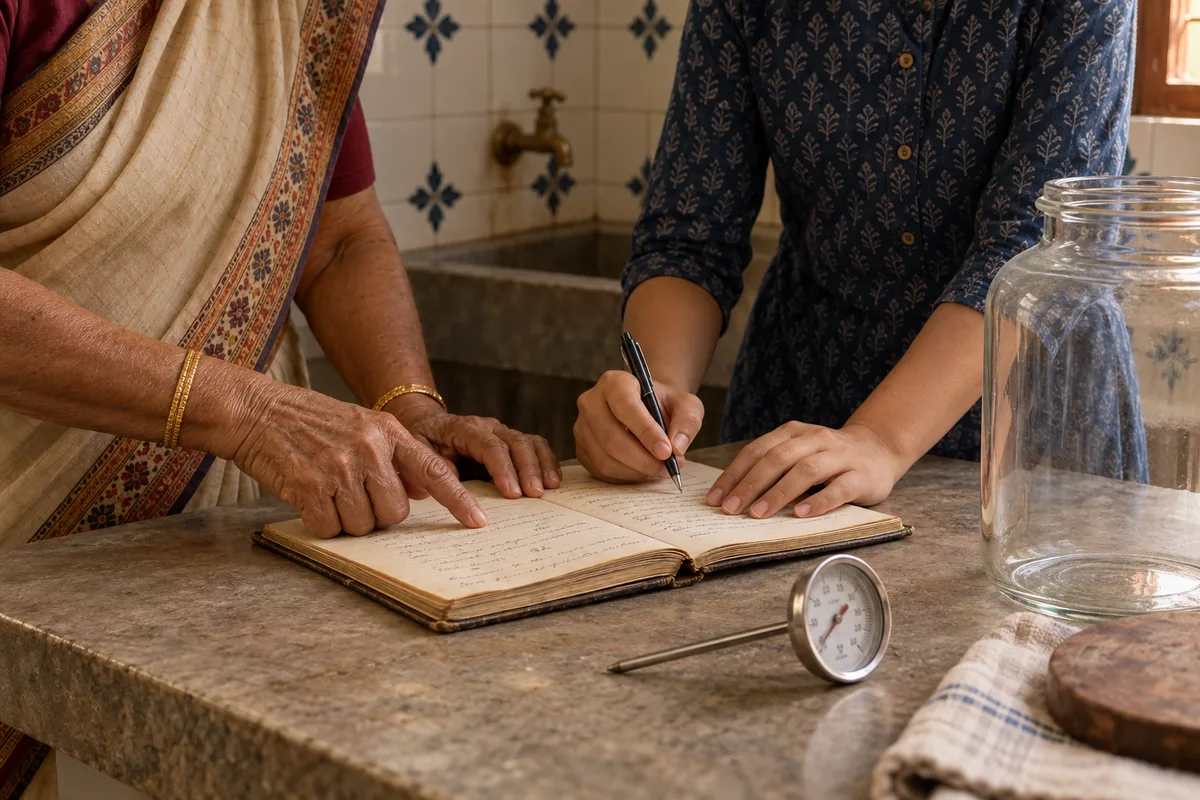
That matters because homemade ferments are not the same as a commercial probiotic drink. Your nani’s dahi carries a diverse, region-adapted community of lactic acid bacteria, a community shaped by your family’s food and climate. A packaged probiotic yogurt carries one or two standardised strains chosen for shelf life. Both can be useful; they are not equivalent. Swapping homemade dahi for packaged flavoured yogurt, or stopping the fermentation habit entirely, removes a daily dose of live cultures and the organic acids they produce.
The masala dabba as a microbiome toolkit
Indian cooking uses spices in combinations that are unusual worldwide, and several act directly on the gut. Turmeric is the best studied. Its compound curcumin has shown effects on gut bacteria and intestinal inflammation in animal research, and a small pharmacokinetics study in 10 volunteers found that a single dose of black pepper, which contains piperine, raised curcumin blood levels roughly twenty-fold (Shoba, Planta Medica, 1998). The doses used in that study were far above what a tadka delivers, but the mechanism is real: piperine slows the breakdown of curcumin. Our ancestors combined the two in the same dishes for generations without a single clinical trial.
The human evidence for most spices is thinner than the animal data, so it is worth being honest about the limits. What is clear is that spice-rich cooking delivers polyphenols and other compounds that a bland, processed diet does not. The honest takeaway is not “turmeric cures anything” but “a spice-rich, plant-heavy diet feeds a broader microbial community than a bland one.”
The microbiome you inherit at the dinner table
Your gut community is partly inherited, and not just through genes. Babies pick up their first microbes during birth and breastfeeding, and food shapes the rest. A child raised on home-cooked Indian food, homemade dahi, and fermented batters builds a different community than one raised on formula and packaged snacks. Over generations, communities develop microbial signatures that mirror their food traditions.
The worry is real. As cities change how we eat, as processed food replaces home cooking, and as antibiotic use climbs, we may be losing diversity that took generations to build. You can shift your microbiome within days by changing your diet (David, Nature, 2014), but some species, once gone from a community, are very hard to bring back, an extinction dynamic that has been shown to compound over generations in animal studies (Sonnenburg, Nature, 2016). For a realistic sense of how long rebuilding takes in practice, see our timeline for fixing gut health.
Protecting diversity on a budget
No two Indian kitchens eat alike, which is precisely the point: the diversity across regional cuisines is a microbial asset, and the grandmothers’ thali, dal, roti, dahi, seasonal sabzi, is a strong everyday template, which we break down in our piece on the thali as a microbiome masterpiece. The catch is that everyone starts from a different place, and knowing where your own gut stands is the first real step.
How the options compare
| What it is | What it does | Evidence | Cost | Bottom line |
|---|---|---|---|---|
| Traditional dal-rice + ferments | Feeds plant-fermenting bacteria daily | Real and well established | Same as your food bill | The main lever |
| Packaged probiotic yogurt | Adds one or two standardised strains | Strain-specific; variable | Rs 40–100 a day | Not the same as homemade |
| Imported/trendy supplements | Pre-packaged blends, often one-size-fits-all | Varies by brand; check strain-level evidence | Cost varies | Read the label carefully |
| Gut assessment + personalised plan | Reads your actual profile and traditions | Describes what is present in your gut | One-time assessment | Read alongside your doctor |
What actually helps
- Rotate the pulses. Moong one day, toor the next, chole or rajma twice a week. Each legume feeds slightly different bacteria.
- Eat the ferments you already have. Dahi, chaas, kanji, and fermented batter cost almost nothing and deliver live cultures daily.
- Buy seasonal and local. Regional vegetables are cheaper and add fibre and polyphenols that the same rotation of potato-cauliflower rarely provides.
- Cook rice ahead when you can. Cooked and cooled rice forms resistant starch, an extra meal for the bacteria that feast on it.
- Keep the masala dabba active. A daily tadka with haldi, jeera, hing, and ginger is a low-cost way to add bioactives to nearly every plate.
BioMeBar: from guessing to knowing
BioMeBar profiles your unique microbiome and personalises recommendations to what is genuinely there, because with trillions of organisms running your biology, one-size-fits-all does not make sense.
The Indian diet is a microbial asset, but the asset is eroding differently for every person, shaped by region, urban living, antibiotics, and stress. A generic formula ignores all of that. BioMeBar starts by understanding your own microbiome and works from there. With the gut, context matters, and your dietary and cultural context is part of who you are, microbiologically speaking.
Limitations and honest caveats
Most spice research, including curcumin, is dominated by animal studies, and the human evidence is thinner than the wellness content implies. The enterotype framework has been debated since it was proposed, and Prevotella-heavy profiles are associations, not proof of metabolic benefit. Homemade ferments vary in what they actually contain. And no diet change guarantees a permanent, ideal microbiome. This article explains how the Indian diet shapes the gut; it does not promise that eating a specific food fixes anything by itself.
Frequently asked questions
Is roti better than rice for gut health?
Both feed your microbiome. Whole wheat roti adds arabinoxylan fibre, and rice, especially cooked and cooled, forms resistant starch. Variety across the week beats choosing a single winner.
Is packaged probiotic yogurt the same as homemade dahi?
No. Commercial probiotic yogurt usually carries one or two standardised strains. Homemade dahi carries a diverse, region-adapted community of lactic acid bacteria. Both can help, but they are not equivalent.
Do spices like haldi and jeera really affect gut bacteria?
Curcumin and other spice compounds show effects on gut bacteria and inflammation in research, largely from animal studies. The human evidence is thinner, but the direction is consistent, and the amounts used in Indian cooking are safe.
Will my gut change if I move from a village to a city?
Probably, and the shift is usually toward lower diversity, because urban diets contain more processed food and less fibre. It is reversible if you deliberately keep the traditional staples in your routine.
References
- Dhakan DB, et al. The unique composition of Indian gut microbiome, gene catalogue, and associated fecal metabolome deciphered using multi-omics approaches. GigaScience, 2019.
- Louis P, Flint HJ. Diversity, metabolism and microbial ecology of butyrate-producing bacteria from the human large intestine. FEMS Microbiology Letters, 2009.
- Arumugam M, et al. Enterotypes of the human gut microbiome. Nature, 2011.
- Wu GD, et al. Linking long-term dietary patterns with gut microbial enterotypes. Science, 2011.
- Mandhania MH, et al. Diversity and succession of microbiota during fermentation of the traditional Indian food idli. Applied and Environmental Microbiology, 2019.
- Shoba G, et al. Influence of piperine on the pharmacokinetics of curcumin in animals and human volunteers. Planta Medica, 1998.
- David LA, et al. Diet rapidly and reproducibly alters the human gut microbiome. Nature, 2014.
- Sonnenburg ED, et al. Diet-induced extinctions in the gut microbiota compound over generations. Nature, 2016.
This article is educational and is not a substitute for professional medical advice.