
Ten years of bloating after meals, and what he reported in the first five weeks
Raghunath*, a 75-year-old vegetarian man, had lived with post-meal fullness, a swollen belly and colicky pain since a round of antibiotics in 2015. His gut condition was classed as diarrhoea-predominant irritable bowel syndrome (IBS-D).
- Gender
- Man
- Age
- 75
- City
- Trivandrum
- Main concern
- IBS-D: bloating, fullness and colic
- Programme
- Gut test, food plan, daily synbiotic
- Reported through
- Week 19 and ongoing
Symptoms that began after surgery and antibiotics
His troubles began in 2015 after surgery, followed by broad-spectrum antibiotics and a week of ciprofloxacin. Antibiotics save lives, and they can also disturb the community of bacteria in the gut. Whether that explains his case cannot be proven, but it is a common story among people with irritable bowel syndrome, including the diarrhoea-predominant type (IBS-D) he was classed with.
Over the years he tried a low-FODMAP diet, which cuts back on fermentable carbohydrates that feed gas-producing bacteria. It helped, but he found it hard to keep up while travelling. On his intake survey he rated bloating after meals 4 out of 5 and food feeling slow to digest 3 out of 5.
Three parts, started together
A gut microbiome test
A stool sample was analysed to map which bacteria were present and how diverse the gut community was. The report shaped the food plan and the choice of strains.
A food plan built around him
A nutritionist adapted a low-FODMAP approach to his habits: cooked vegetables, oats, soaked-rice kanji, a cumin-coriander-fennel tea, and no ginger because it had upset his stomach before.
A rotating synbiotic
One sachet a day, combining beneficial bacteria with the fibres they feed on. Each month had two phases: weeks 1 to 2 for digestion and motility, weeks 3 to 4 for the gut lining.
What went in, and why
He reported fullness after meals, slow digestion and colicky pain, which point to digestion and motility. So we started with L. rhamnosus GG (5 billion CFU), B. lactis (3 billion) and two L. reuteri strains (3.5 billion in total), plus digestive enzymes (amylase, protease and lipase) to help break food down. To support these strains we added acacia fibre, a gentle soluble fibre that lactobacilli feed on. L. rhamnosus GG is among the most studied strains in IBS and after antibiotics, and L. reuteri is used for motility and colic.
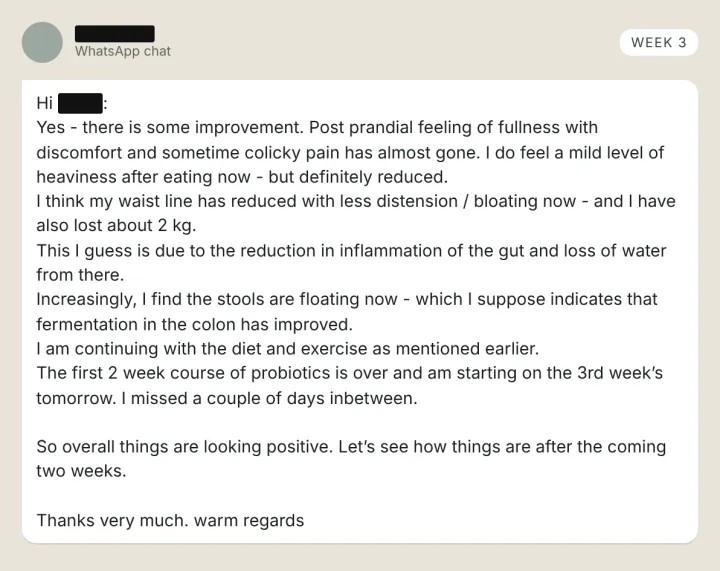
What we observed: by week 3 he reported post-meal fullness and colicky pain almost gone.
His symptoms began after antibiotics, so the second phase turned to the gut lining. We used B. infantis 35624 (1 billion CFU), B. longum BB536 (3 billion), L. plantarum (3 billion) and L. rhamnosus GG (5 billion), with sodium butyrate (the main fuel for the cells lining the colon), zinc L-carnosine (used for lining repair) and quercetin. To support these strains we added partially hydrolysed guar gum, a fibre that feeds them with little gas. B. infantis 35624 is among the best-studied strains for IBS discomfort.
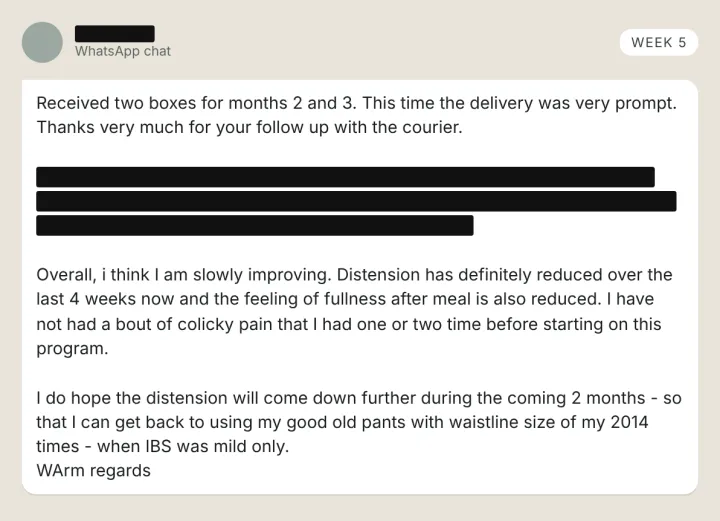
What we observed: by week 5 he reported distension definitely reduced and no colicky pain since starting.
Later months rotated through other combinations so the gut met a changing set of inputs rather than one formula. They included L. fermentum with curcumin, vitamin C and zinc to calm low-grade inflammation; strains studied for the gut-brain axis (B. longum 1714, L. helveticus R0052, L. plantarum PS128) with magnesium and galacto-oligosaccharides, taken in the evening; and B. animalis with a high dose of guar gum for stool normalisation.
What was reported
Fullness and colic easing
“Post prandial feeling of fullness with discomfort and sometime colicky pain has almost gone.”
He also noticed a smaller waistline and about 2 kg of weight loss, and had missed a couple of doses.
Distension down, no colic since starting
“Distension has definitely reduced over the last 4 weeks now.”
He hoped to get back into trousers from 2014, when his symptoms were still mild.
Bloating considerably reduced
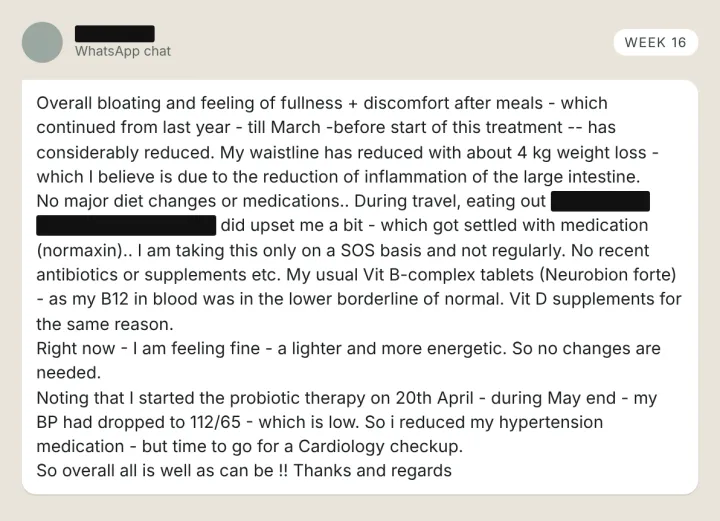
“Right now - I am feeling fine - a lighter and more energetic.”
He reported about 4 kg of total weight loss.
No muscle-relaxant tablets for a month
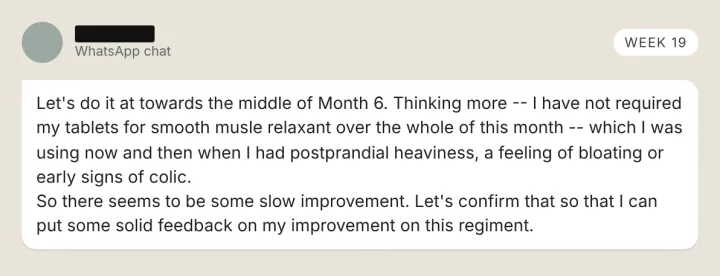
“I have not required my tablets for smooth musle relaxant over the whole of this month.”
He described this as slow improvement; the tablets were something he used when he felt heavy, bloated or early colic.
The evidence
The first change came in the weeks when the lining phase began. By week 3 he reported post-meal fullness and colic almost gone, and by week 5 no colic since starting and a smaller waistline. By week 19 he had stopped needing his muscle-relaxant tablets for a month.
The measures were his own: waistline, weight, colic episodes and tablet use. No lab test tracked these symptoms. He also followed a stricter low-FODMAP diet and exercised during the same weeks.
| When | What he reported |
|---|---|
| Day 5 | Felt normal, no adverse issues |
| Week 3 | Post-meal fullness and colic almost gone, smaller waistline |
| Week 5 | Distension definitely reduced, no colic since starting |
| Week 14 | “The GI system is much better”, very regular |
| Week 16 | Bloating considerably reduced, more energetic |
| Week 19 | No muscle-relaxant tablets needed for the whole month |
Curious what your gut is doing?
Programmes begin with the same gut test. Your plan is built from your own results.
More case studies
See all 8 →Bloating that eased within weeks, and the plan we adjusted as she went
Daily bloating and constipation, and a plan adjusted week by week as she reported back.
Read the case study →Acidity and bloating easing in the first week
Acidity, bloating and stress, and what she reported in her first week on the plan.
Read the case study →* Raghunath is a pseudonym, used to protect the participant's privacy.
Results are individual and not guaranteed. BioMeBar products are nutritional supplements and are not intended to diagnose, treat, cure or prevent any disease. This page is not medical advice; speak with your doctor before changing medication or diet, and before giving any supplement to a child.