
Bloating that eased within weeks, and the plan we adjusted as she went
Ananya* came to us with daily bloating and constipation. This is her plan so far, in her own words. Her programme is continuing.
- Gender
- Woman
- Age
- 72
- City
- Mumbai
- Main concern
- Bloating and constipation
- Programme
- Gut test, food plan, daily synbiotic
- Reported through
- First 6 weeks, ongoing
Daily bloating and slow bowels
On her intake survey Ananya rated bloating after meals 5 out of 5 and acidity 4 out of 5, and she reported severe constipation. She eats a vegetarian, low-FODMAP style diet.
What went in, and why
Her daily bloating and slow bowels pointed to digestion and motility, so we began with L. rhamnosus GG (5 billion CFU), B. lactis (3 billion) and two L. reuteri strains (3.5 billion in total), which are studied for motility and gas, with digestive enzymes (amylase, protease and lipase) to ease the load on a bloated gut. To support these strains we added acacia fibre, a gentle soluble fibre that lactobacilli feed on. Her dose stepped up slowly, from a quarter sachet to a full one.
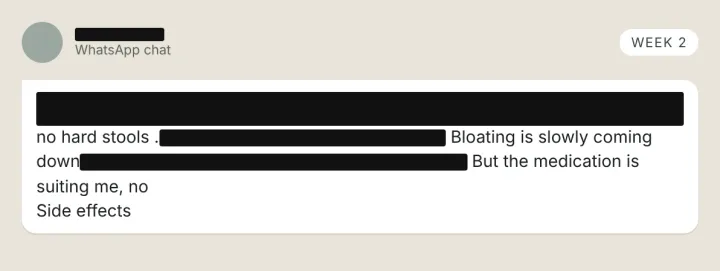
What we observed: in the first days she wrote that bowel movements had improved a little, and by week 2 that bloating was slowly coming down, that she had no hard stools, and that the sachets were suiting her with no side effects.
Bloating had eased but evacuation was still incomplete, so we moved to a morning blend for slow-moving bowels rather than pushing on. We used B. animalis (6 billion CFU), the strain studied for normalising stools, with L. rhamnosus GR-1 (3 billion), L. reuteri (1 billion) and L. gasseri (2 billion). To support these strains we added a high dose of partially hydrolysed guar gum (1 g), a fibre that feeds them with little gas so a bloated gut is not pushed harder. She again started at a quarter sachet and built up.
What we observed: by the fourth week she wrote that she was not bloating much now, that her stools were softer, and that the morning sachet suited her very well.
With dinner we added strains studied for the gut-brain axis (L. helveticus R0052, L. plantarum PS128, B. longum 1714 and B. longum BB536), with magnesium bisglycinate to relax gut muscle and support sleep, and guar gum with galacto-oligosaccharides as the fibre.
We are working on the gut lining first and will return to a lining-repair blend as the lining thickens. It uses B. infantis 35624, B. longum BB536, L. plantarum and L. rhamnosus GG with sodium butyrate and zinc L-carnosine, supported by guar gum.
What we observed: this phase is still to come.
What was reported
Bloating coming down, no hard stools
“Bloating is slowly coming down”
She added that the medication was suiting her, with no side effects.
Bloating down, stools softer
“Not bloating much now. Stools are softer”
She added that the morning sachet suited her very well.

Tolerating the new sachets, no weight gain
“So far so good, they agree with me”
She also reported that she had not put on any weight.

The evidence
From the first quarter-sachet days she noted bowel movements improving, by week 2 that bloating was coming down with no hard stools and no side effects, and by the fourth week that she was not bloating much and that her stools were softer. In week 6 she reported the newer sachets agreed with her and that she had not put on any weight. She also changed her diet in the same weeks. Evacuation was still incomplete, so we adjusted the plan and will work on the gut lining next. Her programme is ongoing.
Curious what your gut is doing?
Programmes begin with the same gut test. Your plan is built from your own results.
More case studies
See all 8 →Acidity and bloating easing in the first week
Acidity, bloating and stress, and what she reported in her first week on the plan.
Read the case study →Fewer toilet trips and steady weight in a boy recovering from surgery
An underweight boy passing stools often after an appendix operation, followed over about six months.
Read the case study →* Ananya is a pseudonym, used to protect the participant's privacy.
Results are individual and not guaranteed. BioMeBar products are nutritional supplements and are not intended to diagnose, treat, cure or prevent any disease. This page is not medical advice; speak with your doctor before changing medication or diet, and before giving any supplement to a child.