
Fewer toilet trips and steady weight in a boy recovering from surgery
Aarav*, a 12-year-old boy, was underweight after an appendix operation and passing stools often. This is his progress over about six months, as his mother described it. Because he takes half a sachet a day, each monthly kit lasts about two months. His programme is now complete.
- Gender
- Boy
- Age
- 12
- City
- Chennai
- Main concern
- Low weight and frequent stools after surgery
- Programme
- Gut test, plan, monthly synbiotic
- Reported through
- About 6 months, completed
Underweight after an appendix operation
After his appendix operation Aarav was lighter than his friends, and he went to the toilet often. His mother wanted a gentle plan that would protect his gut and support weight gain. Children under 30 kg always take half a sachet a day.
What went in, and why
He was underweight after surgery and passing stools often, so we began with strains studied for digestion, nutrient absorption and weight: L. plantarum, B. bifidum, B. breve and L. reuteri (9 billion CFU in total), with digestive enzymes (amylase, protease and lipase) to help him absorb more of what he eats. To support these strains we added inulin, a prebiotic fibre they feed on.
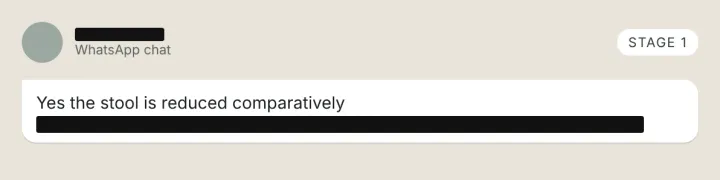
What we observed: as the second week closed his mother wrote that his stools had reduced.
We then turned to calming the gut and supporting immunity with L. rhamnosus GG, B. longum and L. fermentum (7 billion CFU), plus vitamin C, curcumin and zinc, with inulin as the prebiotic.
At a low body weight every calorie counts, so we used digestive enzymes with L. reuteri DSM 17938, the most studied strain for children’s digestion and motility, plus L. rhamnosus GG and B. lactis. Acacia fibre feeds these strains gently.
What we observed: his mother wrote that his toilet frequency was reduced and that he was not rushing to the bathroom as before.
Lining repair came first, using B. infantis 35624, B. longum BB536, L. plantarum and L. rhamnosus GG with sodium butyrate, zinc L-carnosine and partially hydrolysed guar gum. We then added a blend for microbial diversity (L. helveticus, L. gasseri, B. animalis and L. brevis with pectin) and finished with immune balance.
What we observed: his mother wrote that he was doing good, with no other changes.
What was reported
Stools already reducing
“Yes the stool is reduced comparatively”
Written as he began the third week of his first kit.
Fewer toilet trips
“My child’s frequency is comparatively reduced infact he his not rushing to the bathroom as like before.”
Gaining weight is the main goal; for now his weight has held steady while his gut settles.

Doing good
“He his doing good. No other changes for now going on the same way.”
The plan continued unchanged to the end of the programme.

The evidence
His mother wrote early on that his stools had reduced, in the second stage that he was not rushing to the bathroom as before, and by the third that he was doing good. His weight held steady, and gaining weight was the main goal of the programme.
Curious what your gut is doing?
Programmes begin with the same gut test. Your plan is built from your own results.
More case studies
See all 8 →Gas, acidity and pain after meals, and the one sugar behind them
Gas, acidity and pain after meals traced to one sugar, and a diet-only plan over three months.
Read the case study →Clearer thinking and better sleep, measured twice
Brain fog, poor sleep and low mood, measured at two gut tests across two courses.
Read the case study →* Aarav is a pseudonym, used to protect the participant's privacy.
Results are individual and not guaranteed. BioMeBar products are nutritional supplements and are not intended to diagnose, treat, cure or prevent any disease. This page is not medical advice; speak with your doctor before changing medication or diet, and before giving any supplement to a child.