There’s a version of aging that most people accept as inevitable. After 50, you get more digestive complaints. You catch infections more easily. Your energy drops. Your joints ache. Your memory isn’t what it used to be. You’re told this is just what getting older looks like.
And some of it is. But a surprising amount of what we attribute to aging is actually connected to changes in the gut microbiome, changes that are partly modifiable. Not in a "reverse aging with this one trick" way. In a "if you understand what’s happening in your gut, you can slow down some of these processes" way.
What happens to your gut bacteria as you age
The gut microbiome of a healthy 30-year-old and a healthy 70-year-old look measurably different. Several consistent changes show up in research across populations, including Indian cohorts.
Microbial diversity declines. This is perhaps the most well-documented age-related microbiome change. The total number of different bacterial species in your gut decreases, and the community becomes less even, a few species start dominating while others fade. A large 2012 study in Nature (the ELDERMET project) found that elderly individuals living in long-term care had significantly lower microbial diversity than community-dwelling elders, and this diversity correlated directly with measures of frailty, inflammation, and diet quality.
Beneficial bacteria decrease. Specifically, populations of Bifidobacterium (one of the most health-associated genera) decline substantially with age. Faecalibacterium prausnitzii, a major butyrate producer and one of the most important anti-inflammatory species in the human gut, also tends to decline. Akkermansia muciniphila, which maintains the gut’s mucus layer, follows a similar pattern.
Potentially inflammatory species increase. Proteobacteria, including Escherichia and Klebsiella species, tend to increase with age. These bacteria can trigger low-grade inflammation when they grow beyond their usual proportions. The net effect is a shift from a gut community that actively suppresses inflammation to one that promotes it.
Short-chain fatty acid (SCFA) production drops. Because the bacteria that produce butyrate, propionate, and acetate are declining, the overall SCFA output of the gut decreases. This matters because SCFAs do a lot of heavy lifting: they fuel the cells lining your colon, maintain the gut barrier, regulate immune function, and even influence brain health through the gut-brain axis.
Why this matters beyond digestion
If these changes only caused the occasional stomach upset, they’d be a minor inconvenience. But the downstream effects of age-related gut microbiome changes reach essentially every organ system.
The immune system connection is direct and powerful. About 70% of your immune tissue is in and around the gut, and the gut microbiome continuously trains and calibrates immune responses. When the microbiome shifts toward a more inflammatory profile, the immune system shifts too, toward a state called "inflammaging," a term coined by immunologist Claudio Franceschi to describe the chronic, low-grade inflammation that accompanies aging.
Inflammaging isn’t the acute inflammation you get from a cut or an infection. It’s a persistent, system-wide elevation of inflammatory markers (IL-6, TNF-alpha, CRP) that drives tissue damage over years and decades. It contributes to cardiovascular disease, type 2 diabetes, Alzheimer’s disease, and cancer. And the gut microbiome, through its control of intestinal permeability and immune signalling, is one of the primary sources of this inflammation.
In the Indian context, where cardiovascular disease and type 2 diabetes are already epidemic and Indians develop these conditions at younger ages and lower BMIs than Western populations, age-related inflammaging on top of existing metabolic vulnerability creates a compounding problem.
Muscle loss (sarcopenia) also has a gut dimension that’s only recently been appreciated. After 50, most people lose about 1-2% of muscle mass per year. The standard explanation involves declining growth hormone and testosterone, reduced physical activity, and inadequate protein intake. All true. But gut bacteria also influence muscle metabolism through several pathways, SCFA production affects muscle protein synthesis, gut-derived inflammation promotes muscle breakdown, and microbial metabolism of amino acids affects their bioavailability. A 2019 study in Gut Microbes found that elderly individuals with sarcopenia had significantly different gut microbiome profiles compared to age-matched controls with preserved muscle mass.
Cognitive decline has gut connections through the gut-brain axis. The vagus nerve, the body’s longest cranial nerve, provides a direct communication pathway between gut bacteria and the brain. Gut-derived SCFAs cross the blood-brain barrier and influence neuroinflammation, neurotransmitter production, and even brain-derived neurotrophic factor (BDNF), which is essential for memory and learning. Age-related microbiome changes reduce SCFA production and increase neuroinflammatory signalling, both of which have been linked to cognitive decline in elderly populations.
If these changes only caused the occasional stomach upset, they’d be a minor inconvenience.
What’s driving these changes in the first place
Age-related microbiome shifts aren’t caused by aging alone. Several modifiable factors accelerate them.
Diet simplification is a major driver. As people age, their diets often become less diverse, fewer vegetables, more refined foods, less variety overall. In India, this sometimes happens because of dental issues making it harder to eat raw vegetables and certain grains. Sometimes it’s reduced appetite. Sometimes it’s the convenience of familiar, simple foods. Sometimes elders living alone or with reduced mobility eat whatever requires the least preparation.
Each food you stop eating removes a fibre source that was feeding specific bacterial populations. Over years, this dietary narrowing starves out microbial diversity.
Medication accumulation affects the gut significantly. By age 60, many Indian adults are on multiple medications: antihypertensives, statins, metformin, PPIs for acidity, NSAIDs for joint pain. A 2018 study in Nature found that more than one in four commonly prescribed drugs had a significant effect on gut microbial composition. PPIs (proton pump inhibitors) for acidity are particularly impactful: they change stomach pH, which alters which bacteria survive transit to the colon. Long-term PPI use has been associated with reduced microbial diversity and increased risk of Clostridioides difficile infection.
Reduced physical activity changes gut microbial composition independent of diet. Exercise increases microbial diversity and promotes SCFA-producing bacteria. As activity levels drop with age (whether due to joint pain, reduced mobility, or simply habit) the gut loses this exercise-derived microbial benefit.
Social isolation, which affects many Indian elders despite the cultural narrative of joint families, reduces microbial exchange with other people. We share bacteria with the people we live with, eat with, and interact with closely. Isolation narrows microbial inputs.
Want to know what your own gut actually needs? Take the BioMeBar gut assessment →
Practical strategies for the 50+ gut
The good news is that the gut microbiome remains responsive to intervention at every age. Studies have shown that dietary changes can shift microbial composition within days, even in elderly individuals. The microbiome stays responsive at 50 and beyond, provided you give it the right inputs.
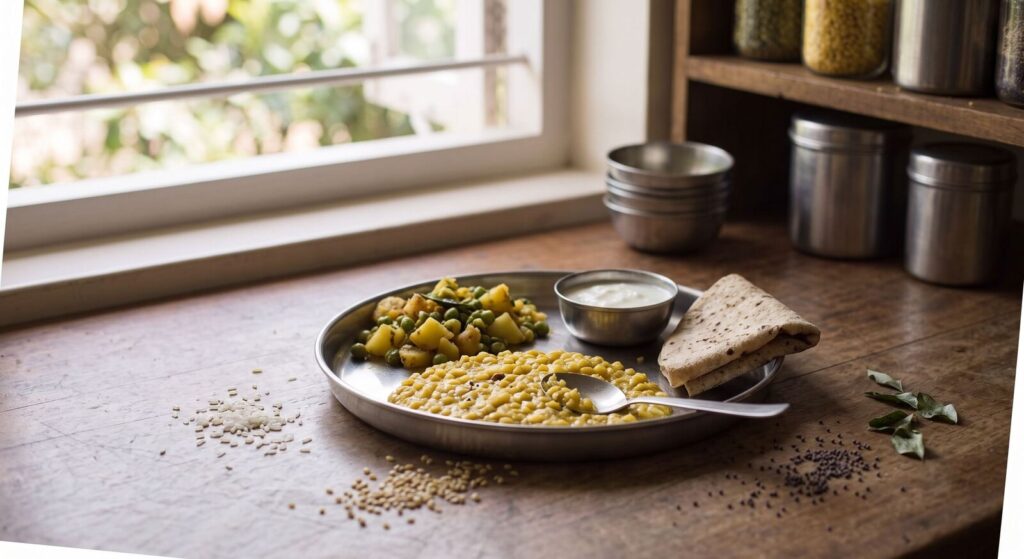
Dietary diversity is the single most effective intervention. This means eating as many different plant-based foods as possible across the week. Different dals (moong, masoor, chana, toor, urad) each provide different fibre profiles. Seasonal vegetables rotate naturally in Indian cooking; lean into this rather than eating the same three sabzis year-round. Include whole grains that you might have dropped, jowar, bajra, ragi, and nachni are excellent prebiotic sources that many urban Indians have replaced entirely with wheat and rice.
Fermented foods become more important with age, not less. Daily dahi provides Lactobacillus species. Fermented batters for idli, dosa, and dhokla provide diverse lactic acid bacteria. Traditional pickles fermented in salt brine (not the vinegar-based commercial versions) are probiotic sources. Even a small serving of fermented food with each meal (a bowl of dahi, a piece of fermented pickle) adds live bacteria to a gut that’s losing diversity.
Protein intake often needs to increase after 50, not decrease. Many Indian elders reduce protein because of digestion concerns or kidney worries (which are usually unfounded in people with healthy kidneys). Adequate protein, about 1-1.2 grams per kilogram of body weight, supports both muscle preservation and gut health. Dal, paneer, dahi, eggs, and fish are excellent sources. Cooking methods matter too, pressure-cooked dals are easier to digest while retaining their fibre and resistant starch content.
Regular physical activity, even gentle activity, makes a measurable difference to gut microbial composition. A daily 30-minute walk, some light yoga, gardening, these aren’t intense exercise, but they maintain the gut-exercise connection. Studies have shown that even moderate activity three to four times per week increases Akkermansia and butyrate-producing bacteria in elderly individuals.
Reviewing medications with your doctor is worth doing periodically. This isn’t about stopping necessary medications: it’s about questioning whether you still need the PPI you were prescribed three years ago for a bout of acidity, whether the NSAID you take daily for joint pain could be replaced with a less gut-disruptive alternative, whether any medications could be reduced or eliminated. Every unnecessary medication you remove gives your gut one less chemical stressor to deal with.
Staying socially connected has biological benefits beyond mental health. Eating with family, interacting with grandchildren, maintaining friendships, these activities involve microbial exchange that supports gut diversity. The Indian tradition of communal eating, sharing food from common dishes, and multi-generational households is actually a built-in microbiome support system.
Aging is inevitable. The rate and severity of age-related gut microbiome decline is not. With attention to diet diversity, fermented foods, movement, and medication management, you can maintain a gut community that keeps working for you well past 50.
If you want to see what’s actually happening in your gut and whether age-related changes are accelerating your health concerns, BioMeBar’s personalised microbiome assessment can show you exactly which bacterial populations have shifted and what can be done about it, because "just getting older" shouldn’t be the end of the conversation.
“But do I really need to test my gut?”
Not everyone does. But if you have been chasing the same symptoms for months — bloating, low energy, mood dips, stubborn weight — guessing gets expensive and slow. Seeing your actual microbiome composition turns trial-and-error into a targeted plan.
Stop guessing. See what is actually in your gut.
BioMeBar profiles your unique microbiome and personalises recommendations to what is genuinely there, because with trillions of organisms running your biology, one-size-fits-all does not make sense.