Does a healthier gut help you sleep, or does better sleep help your gut? Two small but carefully run studies looked at each direction. Together they make a strong case for counting bedtime as part of gut health.
When people come to me about digestion, sleep is rarely the first thing they mention. It’s often the thing that turns out to matter.
Here are two studies that looked at the link from opposite ends, what each one found, and why I think they belong in the same conversation.
Direction 1: gut diversity and sleep quality
In 2019, Smith and colleagues published a study in PLoS One that tracked sleep with wrist-worn activity monitors (actigraphy) and sequenced each participant’s gut microbiome.
What they found: people with a more diverse gut microbiome had higher sleep efficiency (more of their time in bed spent asleep), longer total sleep time, and less time awake after first falling asleep.
What it can’t tell us: this was a small group of 26 men, and it was a correlation. It can’t show whether diverse gut bacteria improve sleep, whether good sleep supports diverse bacteria, or whether a third factor, such as diet, drives both.
Direction 2: what short sleep does to the gut
Benedict and colleagues at Uppsala University tested the other direction in a 2016 study in Molecular Metabolism. Nine healthy young men each spent two sessions in a sleep lab, with the same meals and exercise each time.
In one session they slept normally for two nights. In the other, they were allowed only about four hours a night, from 02:45 to 07:00.
After the short nights: the balance of their gut bacteria shifted, including a higher ratio of two major bacterial groups (Firmicutes to Bacteroidetes) that has been linked with metabolic changes in earlier research. Their bodies also became less sensitive to insulin.
What didn’t change: overall bacterial diversity stayed about the same. The authors describe the effects as subtle and call for larger, longer studies.
Reading them together
Neither study is big enough to settle the question on its own. But they fit together: one suggests gut diversity travels with better sleep, the other shows that even a couple of short nights can nudge gut bacteria and metabolism.
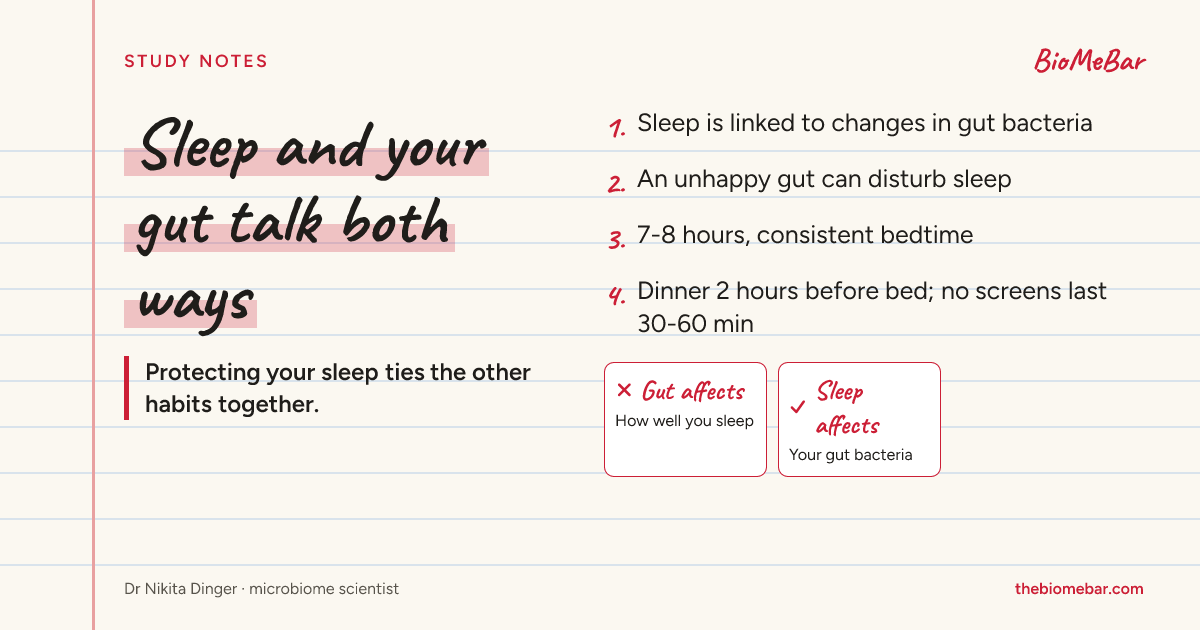
For practical purposes, it doesn’t matter which direction is stronger. Protecting sleep is good for your gut, and looking after your gut is unlikely to hurt your sleep.
An evening routine that serves both
Keep the timing steady. A similar bedtime and wake time every day, weekends included, matters more than an occasional long lie-in.
Give dinner room. Finishing your evening meal two to three hours before bed lets digestion get well under way before you lie down.
Walk after dinner. Ten easy minutes helps with blood sugar after the meal and is a gentle cue that the day is winding down.
Watch late chai and coffee. Caffeine can stay active for many hours. If you sleep poorly, try keeping it to before lunch for two weeks.
Dim the last hour. Lower lights and put the phone out of reach in the final 30 to 60 minutes.
Start with our free gut assessment, or drop us a WhatsApp message with your question.
Limitations and honest caveats
Both studies discussed here were small (26 and 9 men) and short, so their results may not apply to everyone. If you have persistent trouble sleeping, snoring with daytime tiredness, or ongoing digestive symptoms, please see a doctor.
Frequently asked questions
Can poor sleep upset my stomach?
In one lab study, two nights of short sleep shifted the balance of gut bacteria and reduced insulin sensitivity in healthy young men. Many people also notice digestion feels different after a bad night, though responses vary.
Does gut health affect sleep?
A 2019 study found that people with more diverse gut bacteria slept more efficiently and for longer. It showed a link, not cause and effect, so researchers are still working out which way it runs.
How long before bed should I eat dinner?
Two to three hours is a sensible target for most people, giving digestion time to get going before you lie down.
Is a walk after dinner good for sleep?
A gentle walk after dinner supports blood sugar control after the meal and can help signal the end of the day. Keep it easy rather than intense close to bedtime.
References
- Smith RP, Easson C, Lyle SM, et al. Gut microbiome diversity is associated with sleep physiology in humans. PLoS One. 2019;14(10):e0222394. PMID 31589627. doi:10.1371/journal.pone.0222394
- Benedict C, Vogel H, Jonas W, et al. Gut microbiota and glucometabolic alterations in response to recurrent partial sleep deprivation in normal-weight young individuals. Mol Metab. 2016;5(12):1175-1186. PMID 27900260. doi:10.1016/j.molmet.2016.10.003
This article is educational and is not a substitute for professional medical advice.