The gut-brain connection is real, and it is also one of the most over-sold ideas in wellness. Here are four things you’ve probably heard, sorted into what holds up and what doesn’t.
If you have ever felt your stomach drop before an exam or lost your appetite during a hard week, you have felt the gut-brain axis at work.
The science behind it has grown enormously in the last fifteen years. So has the marketing. Below are four claims I hear often, checked against two solid reviews of the research.
Claim 1: "Your gut and brain are directly connected." Verdict: true
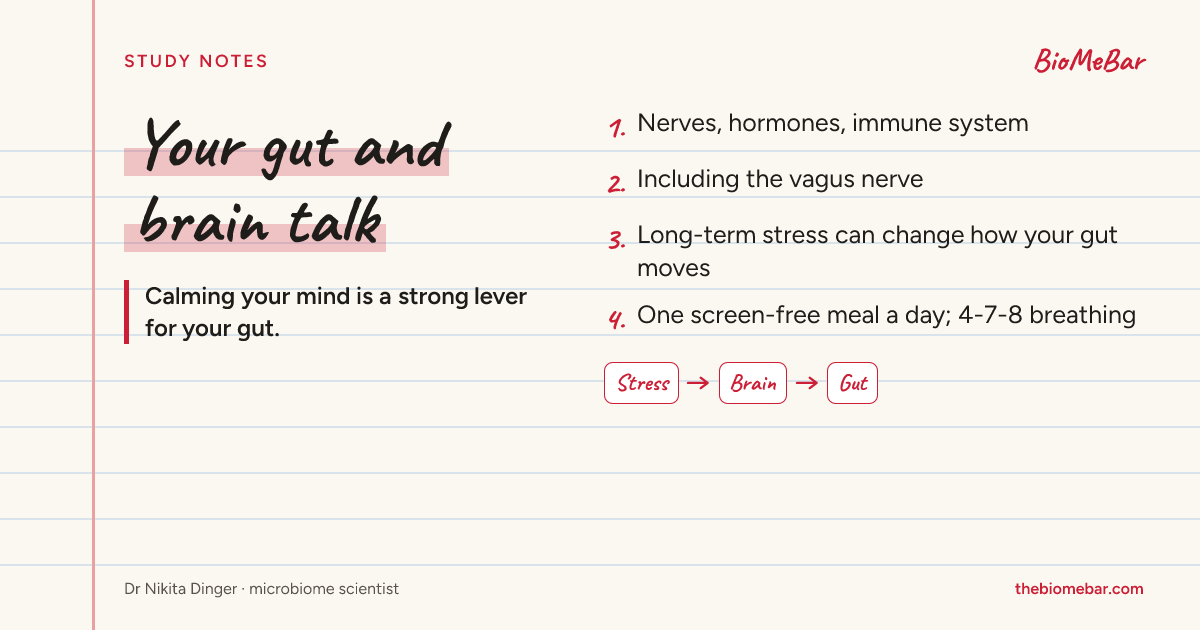
A major 2019 review in Physiological Reviews by John Cryan and colleagues at University College Cork maps out the routes. The gut and brain communicate through the vagus nerve, the gut’s own nervous system (the enteric nervous system), the immune system, and tryptophan metabolism.
Gut microbes are part of the conversation too. They produce molecules such as short-chain fatty acids that can act on these pathways. That’s why researchers now talk about a microbiota-gut-brain axis, not just a gut-brain one.
Claim 2: "Stress shows up in your gut." Verdict: well supported
The same review singles out stress as something that can significantly affect the microbiota-gut-brain axis at every stage of life, from early childhood to old age.
In everyday terms: the nervous system that is busy preparing you for a deadline is the same one that sets the pace of digestion. When it’s in a high-alert state, digestion is not its priority.
Claim 3: "A probiotic can fix your mood." Verdict: not established
This is where the marketing runs ahead of the evidence. Cryan’s review describes a fast-growing field, with much of the strongest mechanistic work done in animals. Human studies are smaller and more mixed.
So be wary of any product promising to change your mental health through your gut. If you’re struggling with low mood or persistent worry, please speak to a doctor or a mental health professional. That’s the evidence-based first step.
Claim 4: "Breathing exercises can change how your body feels." Verdict: promising, with limits
A 2018 systematic review in Frontiers in Human Neuroscience by Zaccaro and colleagues looked at slow-breathing techniques, under 10 breaths a minute, in healthy people. It found only 15 studies good enough to include, but they pointed the same way: slow breathing increased heart rate variability, a marker of the calming parasympathetic system, and people reported feeling more relaxed and less anxious.
None of those studies measured digestion directly. But the parasympathetic system is often described as the “rest and digest” branch, so it’s a reasonable, free, low-risk thing to try before meals.
What I would actually do with this
Sit down to eat. Meals eaten standing, scrolling or answering emails get less of your nervous system’s attention.
Slow your breathing for one minute before a main meal. Breathe in through your nose for about four seconds and out for about six. That’s roughly six breaths a minute, within the range studied.
Notice your own pattern. Keep a simple note for a week: stressful day, how did digestion feel? Many people find a link they had never connected.
Look after the basics that feed both ends of the axis: regular sleep, varied plant foods, and some daily movement.
Take our short gut assessment, or message us on WhatsApp. We read every question.
Limitations and honest caveats
Much of the gut-brain research is early, and many findings come from animal studies. This article is general information. If you are experiencing ongoing low mood, worry or digestive symptoms, please see a doctor or a qualified mental health professional.
Frequently asked questions
Is the gut really a second brain?
The gut has its own large network of nerves, the enteric nervous system, which can run digestion fairly independently. “Second brain” is a nickname, not a scientific claim that the gut thinks.
What is the vagus nerve?
A long nerve that connects the brain with many organs, including the gut. It carries signals in both directions and is one of the main routes of the gut-brain axis.
Can stress change my gut bacteria?
Reviews of the research describe stress as one of the strongest influences on the gut-brain axis, including the microbiota. How much it changes an individual’s bacteria varies from person to person.
Which breathing technique is best before meals?
Any slow, comfortable rhythm under about 10 breaths a minute is in the range researchers have studied. Breathing in for four seconds and out for six is a simple one to start with.
References
- Cryan JF, O’Riordan KJ, Cowan CSM, et al. The microbiota-gut-brain axis. Physiol Rev. 2019;99(4):1877-2013. PMID 31460832. doi:10.1152/physrev.00018.2018
- Zaccaro A, Piarulli A, Laurino M, et al. How breath-control can change your life: a systematic review on psycho-physiological correlates of slow breathing. Front Hum Neurosci. 2018;12:353. PMID 30245619. doi:10.3389/fnhum.2018.00353
This article is educational and is not a substitute for professional medical advice.