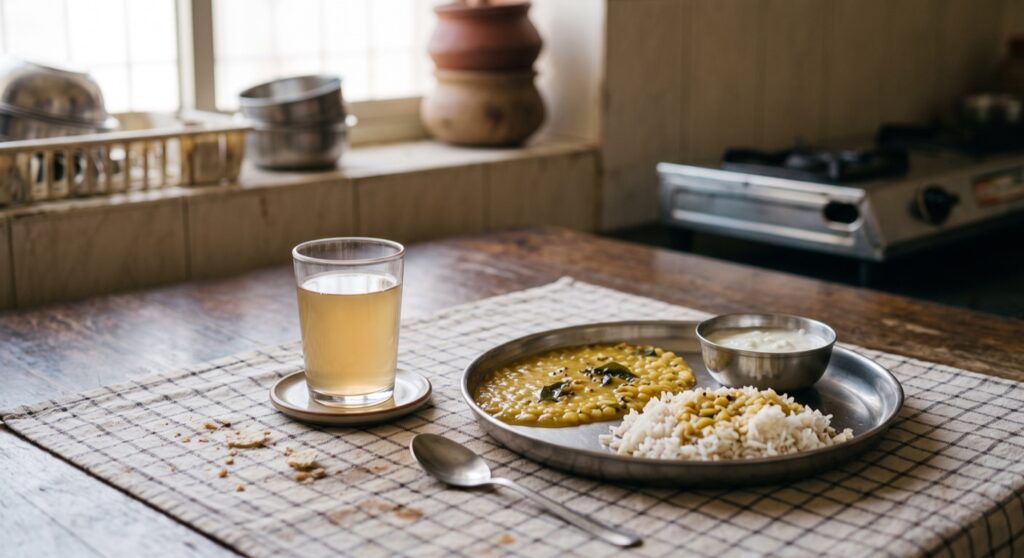
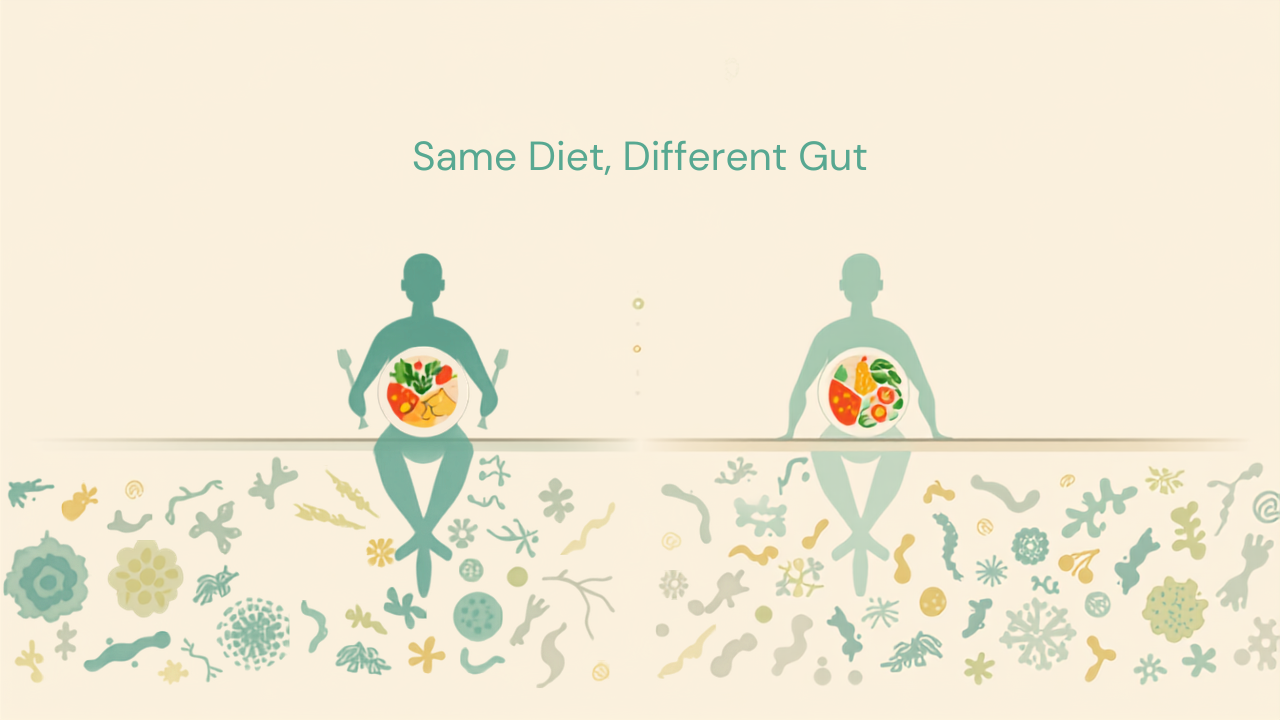

You eat your dal-chawal, sabzi, salad, dahi. The whole balanced-thali routine. Your colleague eats much the same. You’re bloated and irregular. They feel great. So you start wondering: is something wrong with me?
Nothing is wrong with you. Your gut just processes food differently than theirs. And that isn’t a vague wellness claim. It’s one of the best-documented findings in modern microbiome science.
What identical twins reveal

To prove diet alone doesn’t decide gut health, you’d study people with the same genes and the same upbringing. Identical twins are the perfect experiment.
That’s what researchers at King’s College London did in the PREDICT study, one of the largest personalised nutrition studies ever run. They recruited over 1,100 participants, including hundreds of identical twins, fed them standardised meals, and tracked blood sugar, blood fat, and insulin.
The results were striking. Even identical twins (same DNA, same childhood home, often similar diets) responded very differently to the same foods. One twin ate white bread and had a modest sugar rise. The other ate the same bread and spiked hard. Genetics explained only about 30% of the variation in blood sugar response, and even less for blood fat.
So what explained the rest? A big part was the gut microbiome. The twins shared only about 37% of their gut bacterial species. And those microbial differences lined up closely with how they handled food.
Your bacteria decide what happens to your food

Eat a bowl of rajma-chawal and you’re not the only one eating. Trillions of colon bacteria eat too. What they do with that food shapes a lot of how you feel.
Some bacteria are great at breaking down complex carbs and resistant starch, making short-chain fatty acids like butyrate along the way. Butyrate feeds the cells lining your colon, lowers inflammation, and keeps the gut barrier strong. People rich in butyrate producers (like Faecalibacterium prausnitzii and Roseburia) tend to have easier digestion and less gut inflammation.
Other bacteria are better at pulling calories from food. Some microbiomes are so efficient at it that those people gain weight more easily on the same calories. A 2006 study in Nature showed the Firmicutes-to-Bacteroidetes ratio differed between obese and lean people, and that transplanting the "obese" microbiome into germ-free mice made them gain more fat on the same diet.
Then there are gas-makers. If your gut runs high in hydrogen- and methane-producing archaea (like Methanobrevibacter smithii), you might bloat badly on the exact foods your friend eats without a flicker of discomfort.
Same dal, same roti, opposite outcomes. The food isn’t the reason. Who’s processing it is.
Eat a bowl of rajma-chawal and you’re not the only one eating.
Why "I eat well but still have issues" is perfectly normal
This is the part that frustrates people most. You do everything right (whole grains, vegetables, fermented foods, little processed food) and still feel lousy. Meanwhile your cousin survives on Maggi and chai with zero complaints.
The reason: "eat well" is a population-level recommendation, not a personalised prescription. When nutritionists say "eat more fibre," they’re working from large studies showing fibre-rich populations have lower rates of colon cancer, heart disease, and diabetes. True on average. Within those populations, individual variation is huge.
Some microbiomes handle high fibre beautifully. Their bacteria ferment it efficiently, make beneficial SCFAs, and everything runs smoothly. Other microbiomes (especially those with low diversity or dysbiosis) struggle with the same load. The undigested fibre sits in the colon, gas-producers ferment it, and you get bloating, cramps, and discomfort.
A Stanford study found two trajectories when people switched to high fibre. Those with high baseline diversity saw diversity rise further. Those with low baseline diversity saw no gain, and sometimes felt worse.
Your starting point matters as much as what you eat.
Want to know what your own gut actually needs? Take the BioMeBar gut assessment →
It’s not just about digestion
The microbiome’s reach goes well past whether you bloat after lunch. Your gut bacteria shape how you handle blood sugar, which drives your energy through the day. They shape how you metabolise fat, which affects heart risk. They even make neurotransmitters like serotonin and GABA, which affect mood and sleep.
So two people on identical meals can have different energy, different moods, and different long-term health, all from microbial differences.
Weizmann Institute researchers built a machine-learning model that predicted individual blood sugar responses to specific foods. Its most powerful inputs weren’t the nutrition labels. They were each person’s gut microbiome. The same food that was "healthy" for one person (a low sugar response) was "unhealthy" for another (a high spike).
The microbiome’s reach goes well past whether you bloat after lunch.
What this means for you
If you’ve followed all the "right" advice and gotten nowhere, the problem isn’t your discipline. The advice just wasn’t built for your biology. Generic guidelines are starting points, not destinations. They tell you what works for most people on average, which may or may not include you.
Knowing your own microbiome (what bacteria you carry, what they do, what they need) is the difference between guessing and knowing. It’s why two people eating the same thali can have such different experiences. The fix isn’t to eat "better" in some abstract way. It’s to eat right for your particular ecosystem.
“But do I really need to test my gut?”
Not everyone does. But if you have been chasing the same symptoms for months — bloating, low energy, mood dips, stubborn weight — guessing gets expensive and slow. Seeing your actual microbiome composition turns trial-and-error into a targeted plan.
Stop guessing. See what is actually in your gut.
BioMeBar profiles your unique microbiome and personalises recommendations to what is genuinely there, because with trillions of organisms running your biology, one-size-fits-all does not make sense.