
A 17-week randomised trial gives us one of the clearest looks yet at what fermented food does to the gut. Here’s what it found, what it didn’t, and how to use it in an Indian kitchen.
Most people who ask me about gut health have already bought, or are about to buy, a probiotic capsule. My first question back is usually: what fermented foods do you eat?
That isn’t nostalgia for grandmother’s kitchen. It’s because one of the more interesting gut-health experiments of the last few years compared exactly this kind of everyday eating against another popular recommendation, and the result surprised the researchers themselves.
The study: fibre vs fermented food
In 2021, a team at Stanford led by Hannah Wastyk, Christopher Gardner and Justin and Erica Sonnenburg published a randomised trial in Cell. Healthy adults were assigned to one of two diets for 17 weeks: one group steadily increased their fibre, the other steadily increased fermented foods such as yoghurt, kefir, kimchi and fermented vegetables. There were 18 people in each group.
The team sequenced participants’ gut microbiomes repeatedly and ran detailed immune profiling, measuring dozens of inflammatory proteins and immune-cell responses in the blood.
What they found
The fermented-food group’s microbiome diversity rose steadily over the study, and many of their inflammatory markers went down.
The high-fibre group’s diversity did not change over the same period. Their gut bacteria did shift in function, producing more of the enzymes that break down fibre, and how their immune system responded depended partly on how diverse their microbiome was to begin with.
That second finding matters as much as the first. Fibre is still important: it feeds the bacteria you already have. But in this trial, fermented food was what moved diversity.
What it doesn’t show
This was 36 healthy adults in California, eating Western fermented foods. It doesn’t tell us how much any single food contributes, whether the effect lasts once people stop, or how it applies to people with existing gut conditions.
Reviews of the wider literature, such as Marco and colleagues in Current Opinion in Biotechnology (2017), make the same point: fermented foods can carry live microbes and useful compounds formed during fermentation, but there are still relatively few clinical trials. Read the Stanford result as a strong, promising signal, not a final answer.
Translating it to an Indian kitchen
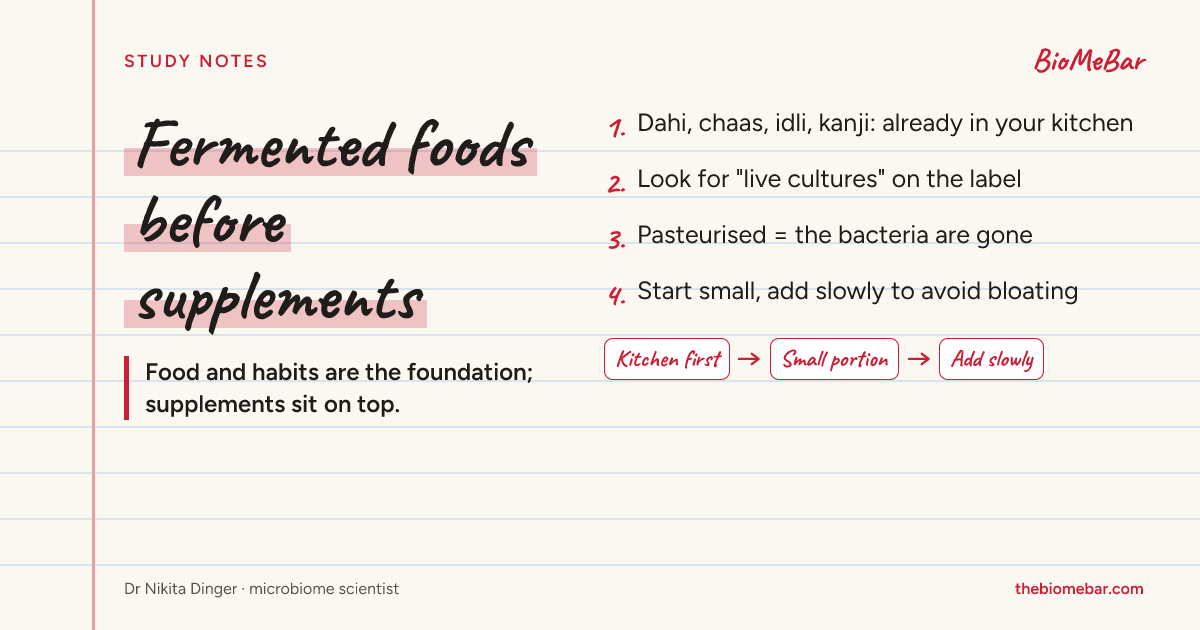
India has one of the richest fermentation traditions in the world, and much of it is already on your plate: fresh dahi, chaas, idli and dosa batter, dhokla, kanji, and traditionally fermented achaar.
Homemade usually beats shop-bought. Fresh dahi set at home is full of live bacteria. Many packaged products are pasteurised after fermentation for shelf life, and the heat kills the microbes.
Read the label. For yoghurt, buttermilk and similar products, look for “live cultures” or “live and active cultures”. Long-life pickles and sauces made with vinegar are usually not live fermented foods at all.
Variety helps. Different fermented foods carry different microbes. Rotating dahi, chaas, idli batter and kanji through the week gives your gut more to work with than one food every day.
How to start without the bloating
In the Stanford trial, participants built up gradually rather than jumping straight to large amounts. That’s the approach I recommend too.
Week 1: one small katori of fresh dahi or a glass of chaas a day. Week 2: add one more fermented food, such as idli for breakfast or a small glass of kanji. Week 3 onwards: aim for two to three servings across the day, spread out.
If you notice gas or bloating, hold at the level that feels comfortable for a week before increasing again.
So should you skip probiotic capsules?
Not necessarily. Specific probiotic strains have evidence for specific uses, and what helps depends on the strain. But for most healthy people looking to support their gut day to day, fermented foods are the cheaper, broader and better-tested starting point. Supplements, if you use them, should sit on top of that foundation, not replace it.
Every gut responds differently. Our gut assessment is a simple first step, or message us on WhatsApp with your questions.
Limitations and honest caveats
The main trial discussed here was small (36 people), short (17 weeks) and in healthy Western adults, so its findings may not apply to everyone. If you have a diagnosed digestive condition, a weakened immune system, or are pregnant, talk to your doctor before making significant changes to your diet.
Frequently asked questions
Is homemade dahi better than shop-bought yoghurt for gut health?
Fresh homemade dahi reliably contains live bacteria. Shop-bought products may or may not, depending on whether they were pasteurised after fermentation, so check for “live cultures” on the label.
Do Indian pickles count as fermented food?
Only traditionally fermented ones, made with salt and time. Many commercial pickles are made with vinegar or are heated after bottling, so they don’t contain live microbes.
How much fermented food should I eat a day?
Start with one small serving and build up over a few weeks to two or three servings spread across the day, adjusting if you notice bloating.
Are fermented foods the same as probiotics?
Not exactly. Probiotics are specific, tested strains given in defined amounts. Fermented foods contain a varied, less defined mix of microbes plus compounds formed during fermentation.
References
- Wastyk HC, Fragiadakis GK, Perelman D, et al. Gut-microbiota-targeted diets modulate human immune status. Cell. 2021;184(16):4137-4153. PMID 34256014. doi:10.1016/j.cell.2021.06.019
- Marco ML, Heeney D, Binda S, et al. Health benefits of fermented foods: microbiota and beyond. Curr Opin Biotechnol. 2017;44:94-102. PMID 27998788. doi:10.1016/j.copbio.2016.11.010
- McFarland LV, Evans CT, Goldstein EJC. Strain-specificity and disease-specificity of probiotic efficacy: a systematic review and meta-analysis. Front Med. 2018;5:124. PMID 29868585. doi:10.3389/fmed.2018.00124
This article is educational and is not a substitute for professional medical advice.