
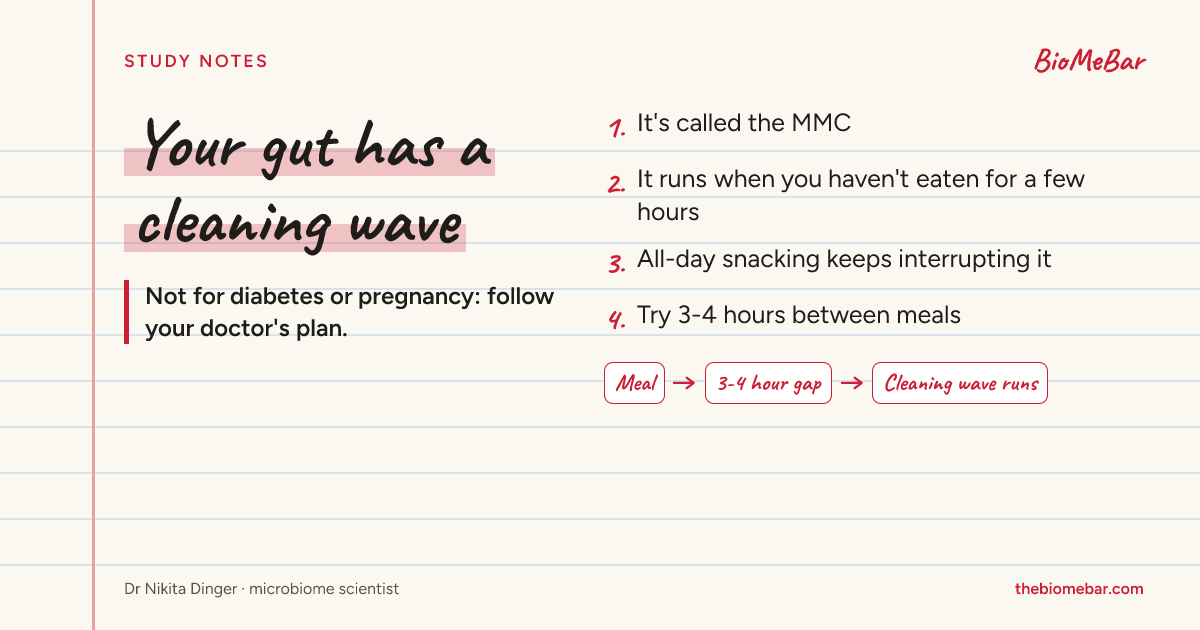
Your gut has a housekeeping routine that only runs when you aren’t eating. Here’s the physiology, hour by hour, and a practical way to give it room.
Most gut advice is about what to eat. This one is about when to stop.
Gastroenterologists have known for decades that the gut behaves completely differently in the fed state and the fasting state. The fasting pattern has a name, the migrating motor complex or MMC, and once you understand it, the habit of grazing all day starts to look different.
A gut timeline: from your last bite onwards
While you eat and for a few hours after: the gut is in its fed pattern. Contractions are irregular and local, mixing food with digestive juices and moving it along slowly so nutrients can be absorbed.
Once the meal has cleared: the fasting pattern takes over. A 2012 review in Nature Reviews Gastroenterology & Hepatology by Deloose and colleagues describes it as a cyclic, recurring pattern in the stomach and small bowel, divided into four phases.
Phase III, the sweep: a burst of strong, regular contractions starts in the stomach or upper small intestine and travels downwards. This is the part often called the gut’s cleaning wave, because it carries undigested particles and bacteria on towards the large intestine.
Then it repeats, for as long as you keep not eating. The moment food arrives, the cycle stops and the fed pattern returns.
Why the sweep matters
The small intestine is meant to hold relatively few bacteria compared with the colon. The sweep is one of the ways the body keeps it that way.
The same review notes that the full role of the MMC is still not completely understood, but that its absence has been associated with gastroparesis (a slow-emptying stomach), intestinal pseudo-obstruction and small intestinal bacterial overgrowth, often shortened to SIBO.
An association is not proof that snacking causes any of these. What it does tell us is that this housekeeping wave is part of normal gut function, and that it needs fasting time to happen.
What interrupts it in a typical Indian day
Picture a common office day: tea and biscuits at 8, breakfast at 9, a mid-morning chai, lunch at 1:30, namkeen at 4, tea again at 5:30, dinner at 9:30, and something sweet at 10:30.
That’s eight eating occasions. Each one, even a small one, puts the gut back into its fed pattern. On a day like that, the only long stretch the MMC gets is while you sleep.
Milky, sweetened chai counts as eating here. So do fruit juice, a handful of nuts and a spoon of mithai.
A spacing plan you can actually follow
Step 1: count your eating occasions for two days. Write down everything that isn’t water or plain black tea or coffee. Most people are surprised by the total.
Step 2: merge the small ones into meals. Have the biscuit with breakfast rather than an hour before it. Move the 4 pm namkeen into lunch, or make it a proper snack and drop another one.
Step 3: aim for three to four hours between eating occasions, with water, plain tea or jeera water in between.
Step 4: protect the night. Finish dinner earlier where you can, and aim for roughly 12 hours between the last food of the day and breakfast. If dinner is at 9, breakfast around 9 the next morning gets you there.
Who should not stretch their meal gaps
Longer gaps are not right for everyone. If you have diabetes or take medicines that lower blood sugar, are pregnant or breastfeeding, have a history of disordered eating, or are underweight, keep to the eating pattern your doctor or dietitian has set for you.
If you have ongoing digestive symptoms, get them assessed rather than experimenting on your own.
Our gut assessment is a simple place to start. Or send us a message on WhatsApp and ask us anything about meal timing.
Limitations and honest caveats
This article explains normal gut physiology from a review of the research. It is general information, not a diagnosis or a diet plan, and doesn’t replace advice from your own doctor.
Frequently asked questions
What is the migrating motor complex?
A repeating cycle of contractions that runs in the stomach and small intestine when you are fasting. Its strongest phase sweeps undigested material and bacteria along the gut. Eating stops it.
Does chai with milk break the gap between meals?
Yes. Milk and sugar are food, so they switch the gut back to its fed pattern. Plain water, plain black tea or black coffee are the usual in-between drinks.
How long should I leave between meals?
For most healthy adults, three to four hours between eating occasions and about 12 hours between dinner and breakfast is a reasonable target. People with diabetes, pregnant women and anyone with a medical eating plan should follow their doctor’s advice.
Is eating six small meals a day bad?
It isn’t harmful for everyone, and some people need it for medical reasons. But it leaves very little fasting time for the migrating motor complex to run during the day.
References
- Deloose E, Janssen P, Depoortere I, Tack J. The migrating motor complex: control mechanisms and its role… Nat Rev Gastroenterol Hepatol. 2012;9(5):271-285. PMID 22450306. doi:10.1038/nrgastro.2012.57
This article is educational and is not a substitute for professional medical advice.